
Survey Solutions v.26.09 Release Notes This release introduces a number of enhancements across data collection, questionnaire design, security, localization, and data export. These improvements provide survey designers and administrators with greater flexibility, stronger security options, and richer operational data.
- Audio Audit Playback.
- Greater Control Over Location Sources.
- GPS Provider Information in Paradata.
- Copying Questionnaires with Scenarios.
- Counter of unresolved comments in the Questionnaire.
- Non-Negative Numeric Questions.
- Support for reCAPTCHA v3.
- Filter Questionnaire Change History.
- Target Area Map Name Length Validation.
- Additional Improvements.
Audio Audit Playback
Supervisors and Headquarters users can now play audio audit recordings directly within Survey Solutions web interface during the review of the interviews data. This simplifies quality control workflows by eliminating the need to download recordings before listening to them.
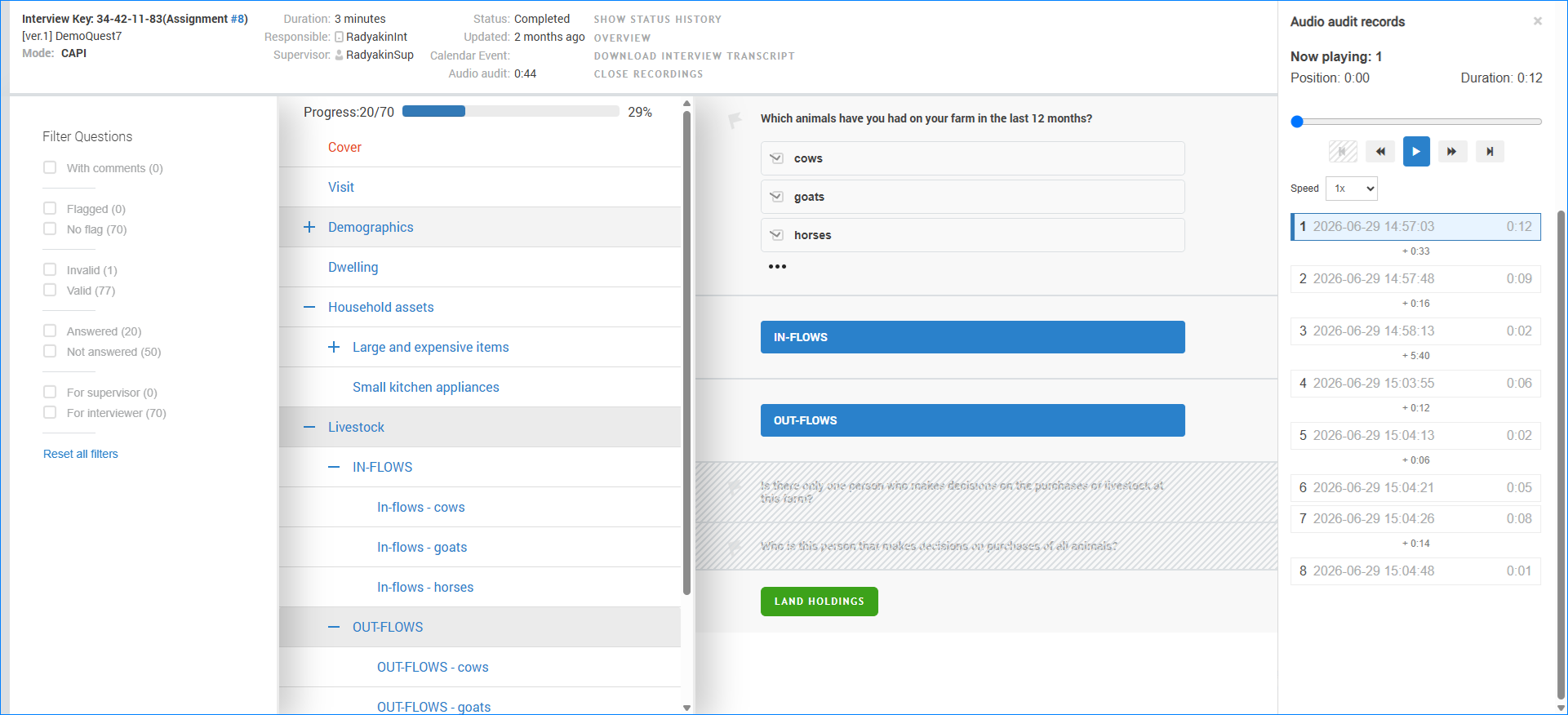
See audio audit playback for more details.
Greater Control Over Location Sources
Administrators can now specify which location sources are permitted when collecting GPS coordinates (at a workspace level). This provides additional control over how location information is captured in the field and helps align data collection with project requirements. See Workspace settings.
GPS Provider Information in Paradata
Paradata exports now include information about the location provider and mode used when coordinates are collected. This additional metadata can help teams assess the quality and origin of recorded location information. See Paradata format.
Copying Questionnaires with Scenarios
Questionnaire copies can now include associated scenarios. This enhancement makes it easier to duplicate and reuse complete questionnaire configurations when creating similar survey instruments. See Copy Questionnaire.
Counter of unresolved comments in the Questionnaire.
Questionnaire authors utilize comments in the Designer for collaboration. The number of unresolved comments is now shown overlaying the comments tool in the panel of advanced instruments. See Comments in Designer
Non-Negative Numeric Questions
The numeric question type now allows entry of non-negative values only by default. This simplifies questionnaire design for variables that cannot logically be negative and reduces the need for custom validation conditions. Negative values can still be permitted if needed. Users will find that in older questionnaires containing numerical questions so that their behavior is not distorted by this change. See Numeric Question.
Support for reCAPTCHA v3
Survey Solutions now supports Google reCAPTCHA v3. Administrators can choose this invisible CAPTCHA mechanism to help protect web questionnaires from automated submissions while minimizing interruptions for respondents. See CAPTCHA Setup.
Filter Questionnaire Change History
Questionnaire change history at the Designer can now be filtered, making it easier to locate specific modifications and review the evolution of a questionnaire over time. See Recent Changes to the Questionnaire.
Expanded Language Coverage
All Survey Solutions subsystems have been translated into the full set of supported languages (earlier some components were lacking translations, for example Interviewer had been available in Vietnamese, but the Headquarters not). In addition, Albanian is now available as a supported language throughout the platform, improving accessibility for a wider range of users. See Language.
Target Area Map Name Length Validation
To improve consistency and prevent operational issues, Survey Solutions now enforces a limit on the length of target area map names. See Survey Solutions Limits.
Additional Improvements
This release also includes performance improvements, bug fixes, and other minor enhancements aimed at improving overall user experience and platform reliability. We thank the users that reported the issues via the public forum, issue tracker, and direct communication.